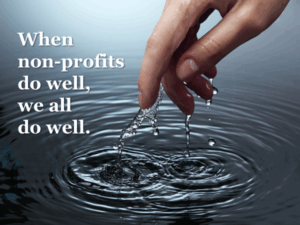
Fountain of Hope
When Gallup surveyed adults around the world what counts as the most positive influence in their daily lives. Hope stands out at the top of the list for 56% followed by trust, compassion and stability. Let’s not mince words: These are not the most hopeful times. Our nation is alarmingly polarized and divided. Unfortunately, this goes beyond parties, candidates and viewpoints. It has escalated to the point of disliking, mistrusting and being unwilling to work with or even listen to those who share different ideas. Sadly, the divisions are only getting worse. There couldn’t be a better time for American philanthropy — the voluntary sharing of time, talent and treasure — to flex its muscles and remind us that more is possible that we can indeed take matters into our own hands and forge a brighter, stronger and more socially just future.
Four central themes come immediately to mind:
(1) Philanthropy is embraced by people from all different socio-economic backgrounds and fueled by the inspiring 13 million professionals and nearly 80 million unpaid volunteers. Donations of nearly $600 billion annually energize the good works of our nation’s 1.5 million non-profits.
(2) Philanthropy is proof positive of bringing together people from diverse backgrounds and with different viewpoints for the common good. When people choose to donate time and money to a favorite non-profit or cause, they don’t research the political underpinnings of the leadership of the organization; they do so because of their conviction in the mission. Indeed, they are kindred spirits of true believers in welcoming responsibility for touching, improving and saving more lives, especially helping those who are struggling.
(3) By helping others, we are truly helping ourselves. Research documents that those who donate precious gifts of time and money live longer, healthier and happier lives.
(4) It can seem like the problems surrounding us are so overwhelming that we don’t know where to start. But by living the spirit of Abraham Lincoln’s “better angels of our nature,” and reading to one child at a time, putting a smile on the face of one senior at a time, fostering one stray cat or dog at a time, introducing the arts to one underserved person at a time and a host of other ways we can engage with one person at a time, we reinvigorate the sense of hope and perpetuate the American tradition that sharing and caring for one another is an awesome, plentiful and renewable fountain of hope.
NPD: Happy 40th
On the theme of saluting and expressing our gratitude for everything that philanthropy — the voluntary sharing of time, talent and treasure — does to make life better for all, let us make sure that we count these blessings on National Philanthropy Day that is celebrated annually on November 15. This day spotlights the importance of working together for the common good. Philanthropic deeds come in all different shapes and sizes — charitable giving, volunteering, mutual aid — and on National Philanthropy Day, no act of kindness goes unnoticed. President Reagan first proclaimed November 15 as National Philanthropy Day in 1986, and communities all throughout the world have celebrated the importance of this occasion ever since. As background on the extraordinary story behind this special occasion here is a feature that we have published in the past.
Fundraising, Friendsgiving, Fun

As most of you know by now, we are no longer in the webinar business. Instead, we are embracing the full power of virtual events and connection. Our Zoom-based live broadcasts bring together the entire non-profit family and all those who wish to lead healthier, happier and more fulfilling lives. No one has all the answers. But within the confines of our spirited virtual meeting spaces, we have the collective wisdom, experience and personal insights to answer virtually any question. We are proud to feature leading authorities from around the world who have distinguished themselves in a wide range of prominent professions and disciplines. Our overarching goal is audience engagement. The newest segment breaks the audience into three different work groups to reflect on a timely challenge in the ever-changing workplace. Then we have fun exchanging the conclusions reached by each of the groups. Our next broadcast is Wednesday, November 5th, 4 to 5:00 p.m., Central time. Participation is free but you must register here. Note that we have updated our schedule to host a special National Philanthropy Week broadcast on Wednesday, November 19th, 4 to 5:00 p.m., Central time. November 15th falls on a Saturday, so we deemed it wiser to meet mid-week. We are looking forward to you adding your voices to give shout-outs to exciting projects and organizations as well the heroic men, women and children who make them possible.
Fundraising Trick or Treat

In keeping with a century-old tradition, children will dress up in favorite costumes and visit homes throughout their neighborhoods. They will be royally rewarded for their efforts. Americans are projected to spend $3.9 billion on Halloween candy in 2025. We’re not offering candy and sweets to our learning community partners of professional and volunteer non-profit leaders, but we do want to share highlights of the lessons learned in the more than 250 live and or virtual events. Read our EIN Presswire news release on the dos and don’ts on successful resource development. Note to parents: Don’t let the kids eat their stash of candy all at once. If I can remember correctly, we even used to freeze some.
Superhero

MacKenzie Scott has given large, unrestricted gifts to more than 2,450 non-profits during the past six years. The 55-year-old donated $2 billion in 2024 alone, bringing her total gifts to more than $20 billion since 2019. She has been making another round of gifts to organizations being boosted by the largest donations ever received in their respective history, making it difficult to keep up with her overall philanthropy. A three-year analysis from the Center for Effective Philanthropy (CEP) finds that Scott’s no-strings-attached gifts, with a median size of $5 million-plus have had a “transformative effect” on non-profits by helping them expand their impact and become more financially stable. She ushers in a dynamic new direction in philanthropy targeting underserved causes and championing trust-based philanthropy. Her visionary leadership is pumping new life into the potential of what philanthropy can and should be. It is altogether fitting that she is featured as Supergirl in Princeton Alumni Weekly Magazine. She graduated from Princeton in 1992. She has never forgotten more challenging times such as when she tried glueing a broken tooth by herself because she couldn’t afford a dentist. She was on the verge of quitting college as a sophomore for lack of funds. Incidentally The Supergirl cover was drawn by fellow Princeton alumnus Jim Lee who also graduated in 1992.
Women and Girls Deserve More

The Women’s Philanthropy Institute
(WPI) at the Indiana University Lilly Family School of Philanthropy has released the 2025 Women & Girls Index (WGI), the only comprehensive index measuring charitable giving to women’s and girls’ organizations in the United States. This year’s analysis draws on the most recent IRS data and includes both 2022 and 2023, offering the most current look yet at how giving patterns are shifting in the wake of the pandemic and other national events.
For the first time since the Index was created in 2019, giving to women’s and girls’ organizations surpassed 2% of overall U.S. charitable giving — peaking at 2.18% in 2022 before settling back to 2.04% in 2023. This translates to more than $11 billion annually, directed to these organizations.
The report notes extraordinary turbulence and activity across women’s and girls’ issues during 2022 and 2023. In June 2022, the Supreme Court’s Dobbs decision overturned Roe v. Wade, which appears to have spurred donations to reproductive rights and advocacy organizations. The period also saw unusually large-scale giving by major donors, including MacKenzie Scott’s $275 million donation to Planned Parenthood in 2022 and her $640 million open call to 361 community-based organizations in 2023.
Key findings include:
- Giving to women’s and girls’ organizations exceeded 2% of all charitable giving for the first time, reaching 2.18% in 2022 before declining to 2.04% in 2023. This represents more than $11 billion annually.
- Much of the increase was fueled by giving to reproductive health organizations, which saw donations jump nearly 40% in 2022 before declining 10% in 2023, for a net two-year increase of 24%. Even excluding these organizations, giving to women and girls rose 10% in 2022 and 7% across 2021–2023.
- Growth was weaker when adjusting for inflation. Giving to women and girls’ organizations fell by 2% between 2021 and 2023, or 5% when excluding reproductive health organizations.
- Women’s and girls’ organizations rely disproportionately on government grants, which account for around 20% of overall revenue — twice the rate of other U.S. non-profits.
- This is an encouraging sign but there still is so far to go to achieve a greater sense of philanthropic equity.
AI for the Good

Hardly a day goes by in which we don’t hear about Artificial Intelligence or the ubiquitous AI. There is excitement about its potential to boost productivity and make work in virtually every sector easier. At the same time there are serious concerns about the potential impact on eliminating jobs in all kinds of ethical considerations.
We are pleased to see a coalition of foundation leaders launch Humanity AI, a $500 million, five-year initiative dedicated to making sure people have a stake in the future of artificial intelligence (AI). As part of Humanity AI, 10 of the nation’s most well-known foundations supporting the arts, labor and work, democracy, education, and security will drive new investments toward establishing a people-driven future where AI delivers for humanity, strengthens communities, and enhances human creativity. The funders involved are Doris Duke Foundation, Ford Foundation, Lumina Foundation, Kapor Foundation, John D. and Catherine T. MacArthur Foundation, Mellon Foundation, Mozilla Foundation, Omidyar Network, David and Lucile Packard Foundation, and Siegel Family Endowment. The idea is to mobilize philanthropy to ensure that people have a powerful voice to amplify their needs and interests, which are too often left out of discussions around AI.
Humanity AI funders have identified democracy, education, humanities and culture, labor and economy, and security as the priorities and have committed to making grants in one or more of those areas. AI must be used to enhance how people work, rather than replace them. Innovation must not come at a cost to safety and security. From driverless cars to automated decisions about credit and lending, those building and deploying AI must be held to the highest standards to protect people.
The coalition is expected to grow to include other voices addressing the social and cultural impact of AI. Humanity AI partners will begin aligned grantmaking right away, driving new investments across their respective grantmaking portfolios. We cherish its mantra: AI will be what we collectively make it.
Let's Agree to Disagree

Here’s an initiative we would love to see scaled up at a national level. Northwestern University trustee Jennifer Leischner Litowitz (Weinberg ’91) and Alec Litowitz have donated $20 million to the University in support of the newly
renamed Litowitz Center for Enlightened Disagreement. Launched in 2024 as part of the Kellogg School of Management, the center seeks to address rising polarization by teaching students how to productively engage in discourse. It will integrate “principles of logical thinking and enlightened disagreement” into the Weinberg College of Arts and Sciences’ first-year College Seminar. The Center will partner with the Division of Student Affairs to develop and launch a program for students residing on campus; it aims to cultivate open-mindedness and help students identify personal cognitive biases to encourage collaboration despite disagreement. The center is led by psychology and Kellogg Prof. Eli Finkel and Kellogg Prof. Nour Kteily, who plan to build on existing research to address misperceptions, polarization and conflict resolution.
The intent of the center is to teach this type of critical thinking to create a foundation of understanding for constructive discussion and debate. The result may not be agreement, but something equally valuable: enlightened disagreement.
Play Non-Profit Moneyball and Win

One of our favorite movies is “Moneyball,” a biographical sports drama made in 2011 starring Brad Pitt. It tells the real-life story of Oakland A’s general manager Billy Beane’s successful attempt to assemble a baseball team on a lean budget by employing computer-generated analysis to acquire new players. His radical approach to finding budget-friendly talent who can win games revolutionizes the making of great baseball teams.
Modestly inspired by the theme we are pleased to present our 9-part or 9-inning video series highlighting how all non-profits regardless of size, mission and parts of the country by embracing sound principles, proven strategies and data backed up best practices can be productive in advancing their respective missions and developing more resources. Here is the ninth and final episode. You can go to our LinkedIn or You Tube page to review the entire series. Each one is only about a minute or two so you can review them very quickly. We wanted to make sure you could watch them along with the 2025 World Series. Popcorn is optional.
On Bookshelf: Devil Emails At Midnight

In The Devil Emails At Midnight: What Good Leaders Can Learn From Bad Bosses, Mita Mallick shares how bad bosses aren’t born. Bad bosses are made. They are a product of their circumstances. She shares hilarious and heartbreaking stories of the 13 bad bosses she once endured and survived, even including when she was a bad boss in her career. She challenges us both current and aspiring leaders to avoid the pitfalls of bad boss behavior. With powerful storytelling and practical advice, she covers bad behaviors like:
- Never having time for our teams (except at midnight).
- Micromanaging and re-doing all of the team’s work.
- Being completely disengaged and disinterested in leading.
- Ruling with fear in hopes of driving business results.
- Loving the spotlight and taking credit for all of the work and much, much more.
We’ve all endured bosses from hell and painfully learned what not to do once we’ve attained leadership positions. The contents of the book are very easy to relate to.
How Many Millions Are Enough?

One of our most pressing concerns is the ever-widening gap between the haves and the have nots. Scott Ellis, a former McKinsey consultant and Hewlett-Packard executive turned philanthropist now prioritizes his time as Founder and CEO of MasteryTrack, and catalyzing blended learning at scale in America. We’ve never clearly defined what financial success looks like. Ellis wrote an insightful essay for Time addressing “How much is enough?”
Ellis starts with stark reminder: About a third of Americans cannot cover a $500 emergency, and more than 11%—nearly 38 million people — live in poverty. Meanwhile, a tiny fraction of individuals control more wealth than entire nations. This imbalance destabilizes democracy, distorts our economy, and limits human potential. Poverty does more than deprive people of resources. A group of researchers published in Science found that financial strain consumes mental bandwidth, reducing cognitive capacity by the equivalent of losing a night’s sleep. When too much brainpower goes toward meeting basic needs like rent or groceries, long-term thinking and innovation fade, depriving society of creativity and progress. So, Ellis imagines redefining “enough.” With $30 million, a household can secure every conceivable comfort: homes, education, travel, even luxuries most people never dream of. Beyond that point, wealth shifts from living well to wielding power. That power is often used to unfairly influence elections through massive campaign donations, to interfere with independent journalism by buying media outlets, and to suppress competition in markets. Defining $30 million as “enough” isn’t about punishing ambition; it’s about protecting our democracy and preserving the opportunity to dream — for everyone. According to the 2024 Knight Frank Wealth Report, there are about 225,000 individuals in the U.S. with net assets of $30 million or more, just 0.07% of the population. We don’t know about you, but we will settle for $30 million any day of the week.
Quiz: Favorite Charities
The Chronicle of Philanthropy identifies the 100 non-profits that earn the most support from individual Americans, private foundations, and corporate philanthropies. These organizations each raise hundreds of millions of dollars, if not billions, in cash support — specifically, gifts of cash and stock. Also examined is their annual giving from 2018 through 2020 as a baseline to see who’s growing (and how quickly) and who’s not. The ranking is based on average annual support raised by organizations from 2021 to 2023, the last year when full figures are available. Data used in the ranking was compiled from Internal Revenue Service Form 990 filings, audited financial statements, and surveys sent to tax-exempt organizations. Match the following top five charities with their respective gift income. Answers are shown at the bottom of the page.
1. Compassion International a. $1.1 B
2. Salvation Army b. $1.3 B
3. St. Jude c. $1.6 B
4. The Y d. $2.3 B
5. United Way Worldwide e. $2.6 B
Stratagems is published monthly by Jim Eskin, Founder of Eskin Fundraising Training, LLC. We offer workshops and customized training sessions for board members, staff and volunteers of non-profit organizations of all kinds and sizes. For details about our services and information, or to find out how to schedule a training session for your organization, visit our website. Follow our events on Facebook, and read more articles about philanthropy on our LinkedIn page.

Jim Eskin, Founder
Eskin Fundraising Training
Email: [email protected]
Cell: 210.415.3748
www.eskinfundraisingtraining.com

ANSWERS TO THIS MONTH’S QUIZ: 1=e 2=c, 3=d, 4=a, 5=b |